Heimskringla
A Journey to the Centre of the EarthHeimskringla is the old Icelandic book whose hidden parchment sets Professor Hardwigg’s subterranean expedition in motion. A prized object in his study before its contents become a mystery, it supplies the physical and historical clues through which he identifies Arne Saknussemm and begins to pursue a journey into the Earth.
The book in Professor Hardwigg’s study
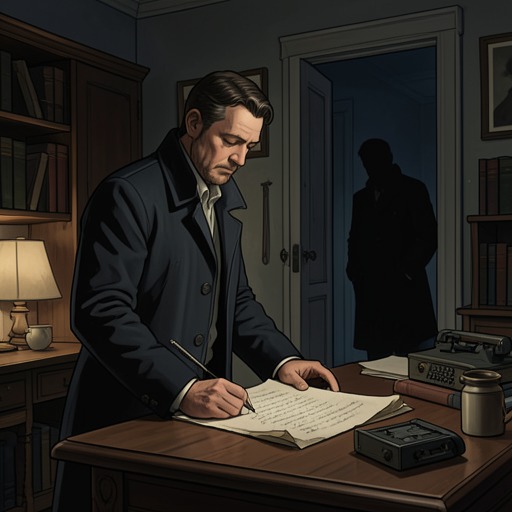
The volume appears in a study that is itself a museum of natural curiosities, with minerals predominating. Henry Lawson knows the specimens well because he has catalogued them, but his uncle is absorbed in the book rather than in the nephew he has summoned. Its yellowed leaves and apparent age initially seem to Henry to promise little; to Professor Hardwigg, they make it a treasure.
His admiration is precise and material. He examines the binding, the clear characters, and the ease with which the book opens in his hand, repeatedly marvelling at its age. This attentiveness establishes the volume not merely as a container of information but as a valued physical artifact: its condition and script are part of what makes it worth studying.
An Icelandic work and its hidden scrap
Professor Hardwigg identifies the book as the work of Snorre Tarleson, whom he describes as a celebrated Icelandic author of the twelfth century, and as an account of the Norwegian princes who ruled in Iceland. He prizes the original Icelandic text rather than a translation, defending Icelandic as both magnificent and simple in expression, though grammatically varied. His scholarly enthusiasm contrasts with Henry’s scepticism and jokes about the difficulty of the writing.
The decisive discovery comes when a small piece of parchment slips from among the leaves. About five inches by three and covered with extraordinary-looking marks, it is seized by Professor Hardwigg before Henry can pursue his joke. The narrator identifies it as the document that will induce his uncle to undertake an extraordinary series of adventures. The book’s importance therefore changes at the moment it yields something concealed: what had seemed an antiquarian possession becomes the archive containing a new, unresolved problem.
Reading the evidence
Professor Hardwigg initially judges the scrap to be written in runic characters, like those in the book, but cannot yet say what they mean. He wonders whether it is a cryptogram or meaningless writing, and compares the document with the volume to test his conjecture. He concludes that the two are in different hands and that the parchment is later than the book. His dating argument turns on its first letter, a double M, which he says entered Icelandic in the twelfth century; on that basis he places the scrap about two hundred years after the volume.
The evidence does not immediately settle the puzzle. Henry finds the professor’s reasoning plausible but still considers it conjecture. Professor Hardwigg proposes that an owner of the book may have written the sentence and turns to the volume to seek that owner’s name. On the flyleaf, what first appears to be an ink blot proves, under close inspection, to be writing almost erased by time. After examining it with a magnifying glass, he makes out the name Arne Saknussemm, whom he identifies as a learned sixteenth-century Icelandic professor and celebrated alchemist.
From scholarly artifact to expedition clue
The sequence makes the book an active link between separate moments of writing: the older Icelandic volume, a later cryptographic scrap, and the nearly effaced ownership note. Each clue changes how the others can be read. The parchment’s difference in hand and date suggests a later intervention, while the name on the flyleaf gives Professor Hardwigg a possible author and historical identity to pursue.
That chain of interpretation is the book’s decisive narrative function. Heimskringla does not itself explain the message, but without the leaves concealing it and the flyleaf preserving Saknussemm’s name, the cryptogram would lack its immediate context. The expedition begins in the professor’s confidence that the book’s physical traces can be read as evidence; the volume turns collecting into investigation, and investigation into action.